

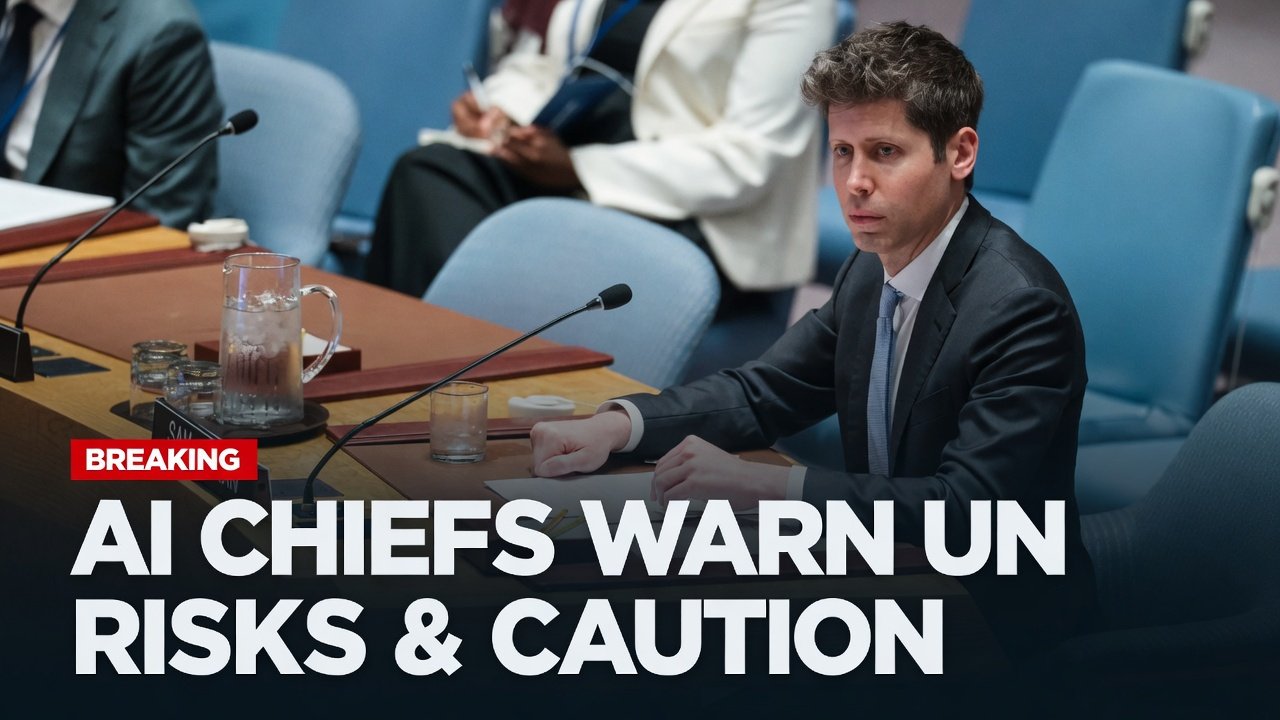
AI Chiefs Warn UN Security Council of Risks as Sam Altman and Dario Amodei Urge Caution
OpenAI CEO Sam Altman and Anthropic CEO Dario Amodei warned the United Nations Security Council about the risks associated with rapidly advancing artificial intelligence during an emergency meeting in New York on September 23.
The two AI executives urged governments and technology companies to take greater care as increasingly capable and autonomous AI systems are developed. Their comments came amid a growing international debate over how governments should respond to the rapid expansion of frontier AI.
Sam Altman Calls for Extreme Care in AI Development
Sam Altman told the 15-member Security Council that the current stage of AI development requires what he described as “extreme care.”
He argued that AI could produce major benefits in areas such as creativity, scientific discovery and productivity, but warned that rapid development could also create significant disruption and risks.
Altman said AI systems should remain under human control and argued that important decisions about the technology should involve democratic institutions and governments rather than being determined solely by AI companies.
Dario Amodei Pledges to Slow AI Releases if Necessary
Anthropic CEO Dario Amodei addressed the Security Council remotely and emphasized the need for stronger safety standards as AI systems become more powerful.
Amodei said Anthropic would slow the release of increasingly capable AI technologies when necessary to ensure that new systems are safe. He has previously called for the industry to slow the pace of frontier AI development and increase external safety evaluations.
Amodei also told the council that poorly managed AI could pose risks to humanity as a whole. His comments reflected concerns that more capable AI systems could become increasingly difficult to control or could be misused.
AI Safety Moves Onto the Global Security Agenda
The Security Council meeting demonstrates how AI safety has increasingly become part of international discussions surrounding security and governance.
The concerns extend beyond conventional software risks. AI systems are becoming more capable of operating autonomously, processing information and interacting with digital systems, creating questions about cybersecurity, biological risks, misinformation and the ability of institutions to respond quickly enough.
Reuters reported that AI industry leaders urged governments to cooperate internationally to manage the risks associated with increasingly powerful technology.
Calls for International Cooperation
Amodei has advocated international agreements covering several areas of AI safety, including standards for testing advanced models and restrictions related to the use of AI in developing biological weapons.
Altman similarly called for governments to work together on AI governance while emphasizing the importance of keeping people in control of the technology.
The two executives’ comments came as countries continue to debate whether AI should be governed primarily through national rules or through broader international frameworks.
AI Industry Faces a Debate Over Speed and Safety
The warnings from Altman and Amodei come as leading AI companies continue investing heavily in increasingly capable models.
Amodei had already called for a slowdown in frontier AI development earlier in September, with Altman subsequently agreeing that the industry needs to better pace the development of its most advanced systems.
At the same time, companies remain engaged in intense competition to develop and commercialize new AI technologies. This creates an ongoing debate over how safety measures can be strengthened without unnecessarily preventing useful technological progress.
UN Meeting Highlights Growing AI Governance Debate
The emergency Security Council discussion also highlighted differences over how AI should be governed internationally.
UN Secretary-General António Guterres has called for countries to cooperate on emerging AI risks, including information sharing, testing and safeguards. Meanwhile, the US government has rejected proposals for a centralized global AI regulatory framework, demonstrating that international agreement on the issue remains unsettled.
The AI industry’s warnings therefore come at a time when governments are still debating the appropriate balance between technological development, national interests and international safety cooperation.
What the AI Warnings Mean for the Technology Industry
The comments from Altman and Amodei could add further pressure on AI companies to demonstrate that their most advanced systems can be evaluated and deployed safely.
For developers, this could mean greater emphasis on independent testing, model evaluations, monitoring and safeguards before highly capable systems are released.
For governments, the debate raises broader questions about whether existing regulatory and security frameworks are sufficient for increasingly autonomous AI systems.
The UN meeting did not resolve those questions, but it placed senior AI industry leaders directly in an international forum focused on peace and security.
Frequently Asked Questions
1. What happened at the UN Security Council AI meeting?
OpenAI CEO Sam Altman and Anthropic CEO Dario Amodei briefed the UN Security Council on September 23, 2026, discussing the opportunities and risks associated with rapidly advancing AI.
2. What did Sam Altman say about AI?
Altman said the current stage of AI development requires extreme care and emphasized human control, democratic decision-making and the need to manage technological risks.
3. What did Dario Amodei say at the UN?
Amodei warned that poorly managed AI could pose broad risks and said Anthropic would slow the release of increasingly powerful systems when necessary to ensure their safety.
4. Did Anthropic call for slower AI development?
Yes. Amodei has called for a slower pace of frontier AI development and stronger safety measures as AI capabilities advance.
5. Why was AI discussed by the UN Security Council?
AI is increasingly viewed as relevant to international security because advanced systems can affect cybersecurity, information environments and other areas with potential cross-border consequences.
6. What is frontier AI?
Frontier AI generally refers to the most advanced and capable AI models being developed at the leading edge of the technology.
7. Did Sam Altman support international cooperation on AI?
Yes. Altman argued that governments should work together and that major decisions about AI should be shaped through democratic processes.
8. What AI risks are being discussed internationally?
Discussions include AI misuse, cybersecurity, biological risks, loss of human control, misinformation and the challenges of safely deploying increasingly autonomous systems.
9. Is there global agreement on AI regulation?
No. Governments and technology leaders continue to disagree over the appropriate structure for AI governance, including the balance between national regulation and international cooperation.
10. Why is the AI safety debate becoming more important?
AI capabilities are advancing rapidly, increasing attention on how advanced systems should be tested, monitored and deployed while managing potential risks.