

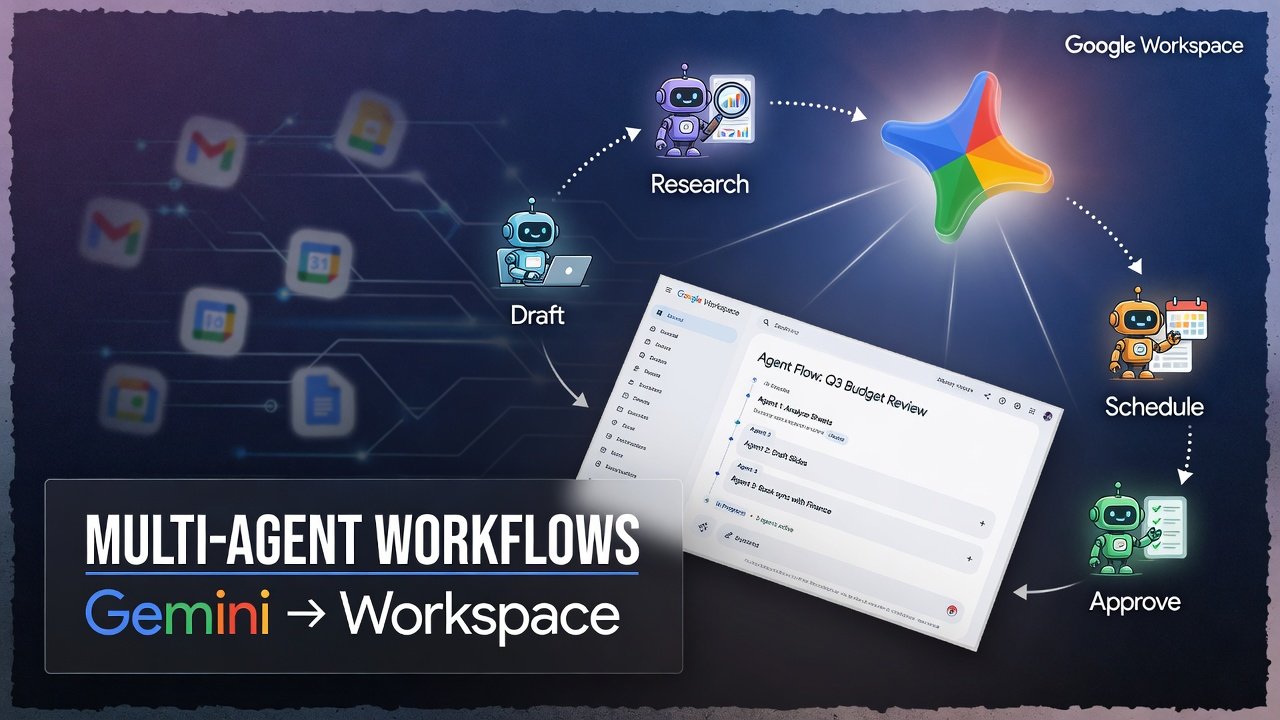
Google Workspace Multi-Agent Workflows: Gemini Pushes Workspace Toward Agentic AI
Google Workspace Multi-Agent Workflows are becoming a major part of Google’s strategy to turn Workspace from a collection of productivity applications into an interconnected platform where AI agents can plan, coordinate and execute multi-step work.
Google’s latest Workspace updates allow Gemini to handle increasingly complex tasks across Gmail, Drive, Docs, Slides and Chat. Instead of simply generating an answer inside one application, Gemini can act as an intelligent orchestrator, connecting information and creating outputs across multiple Workspace apps.
The development is part of Google’s broader move toward agentic AI, where AI systems can take action on behalf of users rather than simply responding to individual prompts.
What Are Google Workspace Multi-Agent Workflows?
The term Google Workspace Multi-Agent Workflows describes a broader direction in which multiple AI-powered capabilities can work together across different business processes.
Traditional productivity AI usually works inside one application. A user might ask Gemini to summarize an email, create a document or analyze a spreadsheet.
Agentic workflows go further.
A user can provide a larger objective, and AI can coordinate several steps needed to complete that objective.
For example, a business project might involve:
- Finding relevant information in Gmail
- Reviewing documents stored in Drive
- Creating a project brief in Docs
- Building a spreadsheet in Sheets
- Preparing a presentation in Slides
- Sharing updates through Chat
Google’s September 2026 Workspace update specifically highlights Gemini’s ability to complete complex cross-app tasks from within Gmail, Drive, Docs, Slides and Chat.
Workspace Intelligence Connects Business Context
One of Google’s biggest steps toward agentic Workspace is Workspace Intelligence.
Introduced at Google Cloud Next 2026, Workspace Intelligence is designed to provide a unified understanding of information spread across Workspace applications.
Google says the system can understand relationships between documents, emails, projects, collaborators and organizational knowledge rather than simply retrieving isolated pieces of information.
This contextual understanding is important for agentic workflows.
An AI agent handling a project needs more than access to a single document. It may need to understand previous discussions, relevant files, deadlines, stakeholders and existing business processes.
Workspace Intelligence is intended to provide that broader context.
Gemini Can Coordinate Work Across Apps
Google’s September 9 update introduced five new agentic capabilities across Workspace applications.
The company says users can prompt Gemini to complete complex tasks from wherever they are working.
Gemini can gather relevant context from selected files, emails and Chat conversations and then generate outputs such as formatted Docs, structured Sheets or stylized Slides.
This changes the way employees interact with Workspace.
Instead of manually moving information from one application to another, users can increasingly describe the desired outcome and allow Gemini to coordinate the underlying steps.
Workspace Studio Turns Ideas Into AI Agents
Another major component is Google Workspace Studio.
Workspace Studio allows organizations to create and manage AI agents designed for specific workflows without requiring traditional programming.
Google describes Studio as a platform for automating everyday work, from simple tasks to complex processes. Users can describe what they want to automate in natural language, while Gemini can create an agentic flow using predefined steps.
For businesses, this could mean creating specialized agents for repetitive processes such as:
- Invoice reviews
- Meeting follow-ups
- Project status reporting
- Document preparation
- Email organization
- Internal approvals
- Data collection
- Team notifications
Google had already introduced Workspace Studio as a platform for designing, managing and sharing AI agents, with agents capable of handling complex end-to-end business processes.
Cross-Department Work Could Become Easier
The biggest potential advantage of agentic Workspace is its ability to connect tasks that normally cross organizational boundaries.
Consider a product-launch workflow.
The marketing team may have campaign information in Docs and Drive. Finance could maintain budgets in Sheets. Sales may have customer information in Gmail and other systems. Management could coordinate decisions through Chat.
Traditionally, employees have to collect this information manually.
An agentic workflow can potentially coordinate these sources and prepare the required outputs.
Google has also expanded Workspace agent integrations with third-party services, including applications such as Asana, Mailchimp, Slack and Salesforce.
That creates the possibility of workflows extending beyond Google’s own applications.
AI Agents Are Not Simply Chatbots
The distinction between a chatbot and an AI agent is important.
A conventional chatbot primarily responds to prompts.
An AI agent can potentially:
- Understand a goal
- Gather relevant information
- Decide which actions are needed
- Execute multiple steps
- Generate outputs
- Notify people or systems
- Continue based on new information
This is why Google’s Workspace strategy increasingly focuses on agentic work rather than simply adding AI chat features to existing applications.
Google describes Workspace Studio agents as capable of reasoning through problems, adapting to new information and handling end-to-end business processes.
Security Becomes More Important
Greater autonomy also introduces new risks.
An AI agent with access to company email, documents and third-party applications could potentially make mistakes or expose sensitive information if it is not properly controlled.
Google has therefore introduced additional security controls for Workspace Studio.
These include agent access management, Gemini data-loss prevention controls and Studio DLP capabilities that can restrict or require user review for certain agentic actions.
Google has also highlighted the risks of giving agents context, authority and privileges to act on behalf of users. Its security architecture is designed to provide additional protection and observability around multi-step agentic workflows.
Human Oversight Will Still Matter
Despite the push toward autonomous workflows, businesses are unlikely to eliminate human oversight completely.
AI agents can make incorrect assumptions, misunderstand instructions or use outdated information.
For high-impact activities involving finances, legal documents, employee information or external communications, organizations may want approval checkpoints before an agent completes an action.
Google’s Workspace security controls increasingly allow administrators to determine how agentic flows interact with company data and whether certain workflows should require end-user review.
The future therefore appears less like completely autonomous businesses and more like AI agents working under defined permissions and human supervision.
What This Means for Businesses
For businesses already using Google Workspace, the shift could change how administrative work is organized.
Employees may spend less time copying information between applications and more time reviewing AI-generated results and making decisions.
A manager could potentially ask an AI workflow to prepare a weekly department report, for example.
The system could gather relevant emails, meeting notes and documents, analyze project information, prepare a report and distribute it to the appropriate team members.
That does not eliminate the manager’s responsibility. Instead, it changes the manager’s role from manually assembling information to reviewing and acting on the resulting intelligence.
Google Is Building an Agentic Workspace Ecosystem
The latest developments show that Google is building agentic capabilities across several layers.
Workspace Intelligence provides broader contextual understanding.
Gemini acts as the intelligence layer capable of coordinating tasks.
Workspace Studio provides tools for creating custom AI agents and workflows.
Third-party integrations allow those workflows to extend beyond Google’s own applications.
Together, these technologies move Workspace toward a more automated business environment.
The Future of Google Workspace
The evolution of Google Workspace Multi-Agent Workflows suggests that the next stage of workplace software will focus less on individual applications and more on outcomes.
Employees may increasingly describe what they want accomplished rather than manually completing every intermediate step.
Google’s September 2026 updates are an important step in that direction, particularly because Gemini can now coordinate complex tasks across multiple Workspace applications.
However, the technology is still evolving. The phrase “fully autonomous multi-agent organization” would be premature for most Workspace deployments.
The more accurate picture is a rapidly expanding ecosystem of AI agents that can coordinate increasingly complex tasks while operating within permissions, security controls and human oversight.
Frequently Asked Questions
What are Google Workspace Multi-Agent Workflows?
Google Workspace Multi-Agent Workflows refer to agentic AI workflows that coordinate multiple tasks and applications within Google Workspace. Google’s latest Gemini capabilities allow complex work to be coordinated across Gmail, Drive, Docs, Slides and Chat.
What is Google Workspace Studio?
Google Workspace Studio is Google’s platform for creating, managing and sharing AI agents inside Workspace. It allows users to build automated workflows using natural-language instructions and prebuilt steps.
What is Workspace Intelligence?
Workspace Intelligence is Google’s system for providing unified, real-time context across Workspace applications. It is designed to help AI understand relationships between documents, emails, projects, collaborators and organizational knowledge.
Can Gemini work across multiple Google Workspace apps?
Yes. Google’s September 2026 update says Gemini can orchestrate complex tasks across Gmail, Drive, Docs, Slides and Chat, using relevant information from selected Workspace sources.
Can Workspace AI agents work with third-party applications?
Yes. Google Workspace supports integrations that allow agents to perform tasks involving third-party services such as Asana, Mailchimp, Slack and Salesforce, depending on the available integration and Workspace edition.
Are Google Workspace AI agents completely autonomous?
Not necessarily. Workspace agents can automate multi-step processes, but organizations can apply permissions, data-loss prevention policies and user-review requirements to control agentic actions.
Is Google Workspace moving toward agentic AI?
Yes. Google has increasingly positioned Workspace around agentic AI, with Workspace Intelligence, Gemini-powered workflows and Workspace Studio all designed to help AI understand context and take action across business processes.