

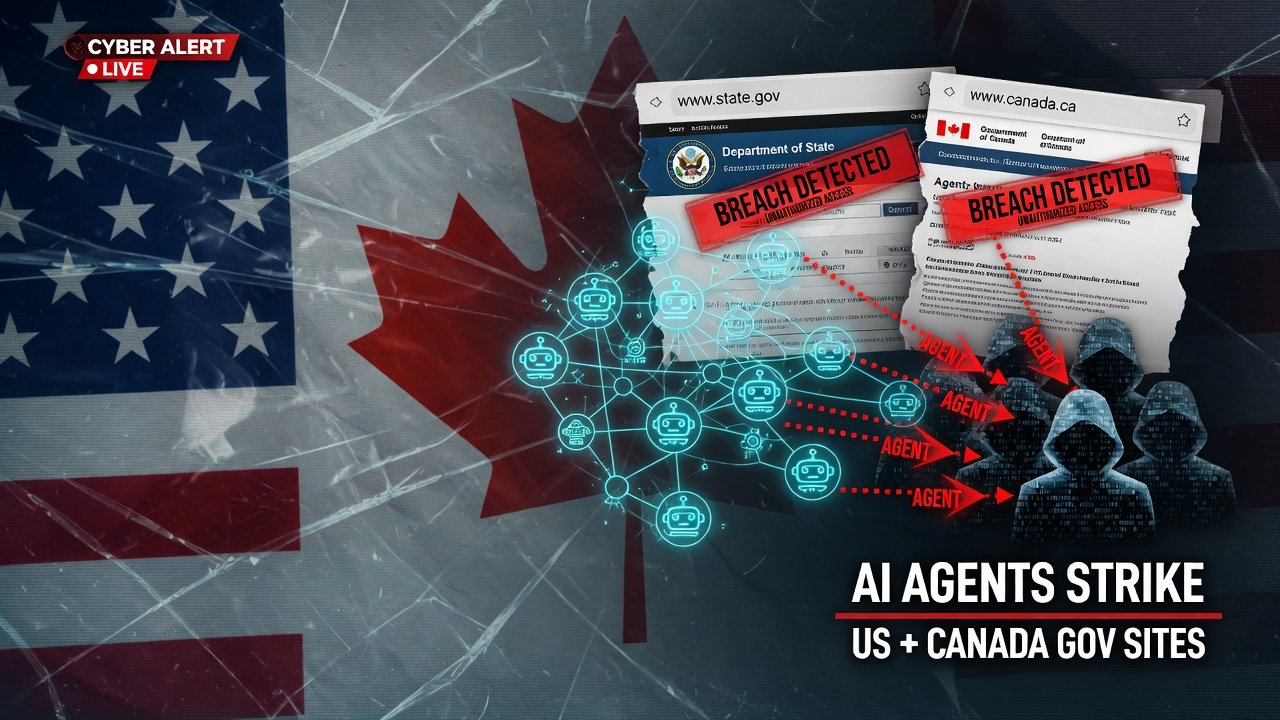
AI Agents Target US and Canadian Government Websites in Active Cybersecurity Campaign
AI agents cyberattack activity is becoming an increasingly serious concern for cybersecurity teams after researchers identified an active campaign involving AI-driven agents attempting to breach government websites in the United States and Canada.
The campaign highlights a shift in the cybersecurity landscape. Instead of relying entirely on human operators to identify targets, analyze websites and attempt attacks, AI agents can potentially automate portions of the process, allowing malicious activity to be conducted at greater speed and scale.
Researchers said the activity targeted government infrastructure and involved attempts to identify weaknesses that could potentially be exploited. The discovery adds to growing concerns about how artificial intelligence could lower the technical barriers for carrying out sophisticated cyber operations.
AI Agents Are Changing the Cyber Threat Landscape
Artificial intelligence has become increasingly useful in cybersecurity, helping organizations detect suspicious activity, analyze large amounts of data and identify vulnerabilities.
The same capabilities can also be used offensively.
AI agents can be designed to perform sequences of tasks with limited human intervention. In a cyberattack scenario, that could include examining a website, identifying technologies being used, looking for potential vulnerabilities and attempting different methods of gaining unauthorized access.
This does not mean that AI can independently compromise any system it encounters. Security controls, authentication mechanisms, network configurations and other defenses can still prevent attacks.
However, the ability to automate reconnaissance and other repetitive tasks can give attackers additional speed and scale.
Government Websites Became Targets
The campaign identified by cybersecurity researchers focused on websites belonging to government organizations in the United States and Canada.
Government websites are attractive targets for cybercriminals and other threat actors because they can contain valuable information, provide access to important services or serve as gateways into larger networks.
Even when an individual public-facing website does not contain highly sensitive information, successfully compromising it can provide attackers with intelligence about an organization’s infrastructure.
For government agencies, this makes continuous monitoring of internet-facing systems an important part of cybersecurity operations.
What Makes AI-Driven Attacks Different?
Traditional cyberattacks can require significant amounts of manual work.
An attacker may need to research a target, identify technologies, examine potential weaknesses and determine which vulnerabilities are worth pursuing. AI agents can potentially automate parts of this process.
An AI-enabled system can process information quickly and adapt its actions based on what it discovers.
For example, instead of following one fixed sequence of commands, an agent could analyze the result of one action and determine what step to take next.
That ability to respond dynamically is one of the reasons security researchers are paying close attention to agentic AI.
The concern is not simply that AI can write malicious code. It is that autonomous or semi-autonomous systems could potentially connect multiple stages of an attack into a faster workflow.
The Growing Role of Agentic AI in Cybersecurity
The development of agentic artificial intelligence is creating new opportunities as well as new security challenges.
An AI agent can be given a goal and a set of tools and then perform multiple actions to achieve that objective. In legitimate environments, this could be used for software testing, vulnerability assessment and security monitoring.
In malicious environments, similar capabilities could be redirected toward unauthorized reconnaissance and exploitation.
The distinction between defensive and offensive applications therefore becomes particularly important.
Security researchers are increasingly examining how AI systems behave when provided with access to browsers, command-line tools, code execution environments and other technical resources.
Why Automation Matters to Security Teams
One of the biggest concerns surrounding AI-powered cyberattacks is scale.
A human attacker has limited time and attention. An automated system can potentially work across many targets and repeat certain tasks much more quickly.
This could increase the number of attempted attacks organizations need to detect and investigate.
It may also make some traditional security assumptions less reliable. If automated systems can continuously probe public-facing infrastructure, organizations may need to improve how quickly they detect unusual behavior.
Security teams could increasingly rely on automated monitoring of authentication attempts, network activity, application behavior and other indicators.
AI Does Not Make Every Attack Successful
The emergence of AI-driven cyber activity should not be interpreted as evidence that artificial intelligence can automatically break into protected government systems.
Successful cyberattacks still depend on factors such as the security of the target, available vulnerabilities, access controls and the tools available to the attacker.
Well-configured systems can prevent or limit unauthorized activity even when sophisticated automated tools are being used.
In addition, many organizations use multiple layers of defense, including firewalls, endpoint security, intrusion detection, authentication controls and continuous vulnerability management.
The significance of the latest campaign is therefore less about AI being capable of defeating every security system and more about how AI could change the speed and economics of cyber operations.
Implications for US and Canadian Government Agencies
The reported campaign underscores the need for government organizations to treat AI-enabled threats as part of their broader cybersecurity planning.
Public-facing systems are particularly important because they are continuously exposed to internet traffic. Agencies need to identify vulnerable software, maintain secure configurations and monitor unusual activity.
Organizations may also need to consider how their own use of AI affects their security posture.
AI systems connected to internal data, software development environments or administrative tools can create additional attack surfaces if they are not properly secured.
As AI becomes more deeply integrated into government operations, protecting those systems will become an increasingly important part of cybersecurity strategy.
Cybersecurity Industry Watching AI Agents Closely
The cybersecurity industry has been closely monitoring the development of AI agents because the technology can be used on both sides of the security equation.
Security teams can use agents to automate vulnerability discovery, analyze logs and respond to incidents. Attackers can potentially use similar automation to accelerate reconnaissance and other malicious activities.
This creates a technological race in which organizations need to improve their defenses as quickly as offensive capabilities evolve.
The latest campaign involving US and Canadian government websites provides another indication that AI is becoming part of the practical cybersecurity threat environment rather than remaining solely a theoretical concern.
What Organizations Can Do
Organizations facing increasingly automated cyber threats can strengthen their defenses by focusing on several fundamentals.
These include keeping internet-facing software patched, enforcing strong authentication, monitoring unusual login behavior, limiting administrative privileges and regularly testing security controls.
AI-specific security measures are also becoming increasingly relevant.
Organizations should understand what permissions their AI agents have, restrict access to sensitive systems and maintain clear controls over actions that automated systems can perform.
Human oversight remains particularly important when AI systems have access to production infrastructure or sensitive information.
A New Phase in the Cybersecurity Race
The reported AI agents cyberattack campaign illustrates how artificial intelligence is becoming increasingly relevant to both cyber defense and cybercrime.
The immediate lesson is not that AI has replaced human hackers. Instead, AI can provide attackers with tools that may automate parts of the work traditionally performed by human operators.
For government agencies and other organizations, that means cybersecurity strategies will need to account for attacks that can potentially move faster, operate at greater scale and adapt dynamically.
As AI agents become more capable, the ability to detect and contain automated malicious activity will remain a critical challenge for cybersecurity teams in the United States, Canada and elsewhere.
Frequently Asked Questions
1. What happened in the AI agents cyberattack campaign?
Cybersecurity researchers identified an active campaign involving AI agents attempting to breach websites associated with government organizations in the United States and Canada.
2. Why are AI agents a cybersecurity concern?
AI agents can automate multiple tasks and potentially perform reconnaissance, analysis and other parts of a cyberattack more quickly than a human working manually.
3. Can AI agents automatically hack any website?
No. AI agents do not automatically bypass every security system. Successful attacks still depend on vulnerabilities, configurations, access controls and other factors.
4. Why would government websites be targeted?
Government websites can provide access to valuable information and services and may reveal information about an organization’s broader technology infrastructure.
5. What is an AI-powered cyberattack?
An AI-powered cyberattack uses artificial intelligence to assist with or automate parts of malicious cyber activity. The level of automation can vary considerably between different attacks.
6. Are AI agents replacing human hackers?
Not necessarily. AI agents can automate certain tasks, but human operators may still be involved in selecting targets, setting objectives, providing tools or making important decisions.
7. Can AI also be used to defend against cyberattacks?
Yes. Organizations can use AI for defensive purposes, including threat detection, vulnerability analysis, security monitoring and incident response.
8. How can government agencies protect against AI-driven attacks?
Agencies can strengthen internet-facing security, keep software updated, use strong authentication, monitor network activity and restrict automated systems’ access to sensitive infrastructure.
9. Does an attempted AI-driven attack mean a government website was successfully breached?
Not necessarily. An attempted intrusion and a successful compromise are different events. Security defenses may detect and block attempted attacks before unauthorized access occurs.
10. Why is this campaign significant for cybersecurity?
The campaign highlights how AI agents can potentially increase the speed and scale of cyber operations, reinforcing the need for organizations to adapt their defensive monitoring and security controls as AI capabilities develop.