

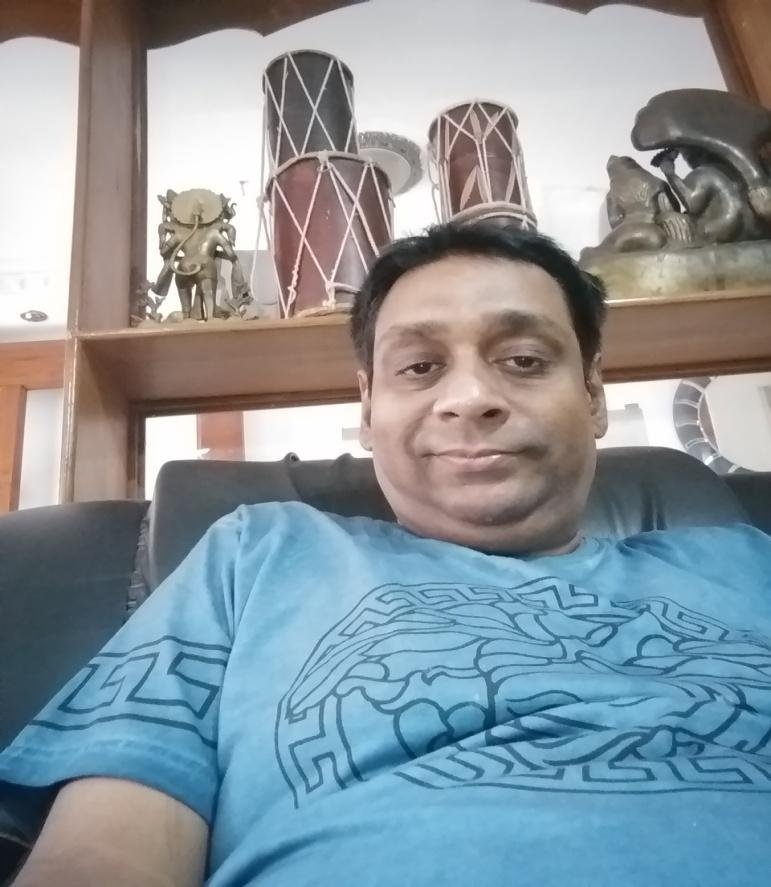
This interview was recorded with Sujay Rao Mandavilli on the 10th of March, 2026
Can you tell us a little bit about your background and a little bit about your mission?
My family hails more or less from an intellectual background. My father was a professor at the Indian institute of technology, Madras. Growing up, I was surrounded by a large number of professors’ children. This naturally kindled my intellectual passion. I was also fascinated with mechanics and mechanical objects. This inspired me to design a fully working and functional telescope when I was just ten or eleven years old. Unfortunately, I made a mistake by getting into commerce which did not suit me at all. However, I eventually got back on track and tried to combine the best of both worlds, by getting into information technology, and later social science. That is why I completed by Masters in Anthropology from the Indira Gandhi National Open University much later, in 2020.
What is the sum and essence of your mission?
Contrary to popular perception, science is very ancient. Anything that follows a scientific method, precision, rigour and scholarly objectivity is called science. Science in a way began way back in the Stone Age when humans accidentally discovered fire, and developed their first stone age tools. Prehistoric science developed independently in different parts of the world, not just in the West. Science in a much more formal sense of the terms began in the Old World civilizations, namely Mesopotamia, Egypt, and the Indus Valley civilization, which were not western in the traditional sense of the term. Even Ancient India and Ancient China contributed to science, and later, the Islamic world. It was only with Ancient Greece that western science really took off. Of course, the West pulled off strongly and impressively with the Renaissance and the Enlightenment, and scientific endeavour has really become lopsided ever since. Asian countries have taken off impressively since the 1970’s, but this is mostly in technology, not in pure and theoretical science. We must distinguish between the two concepts and the two streams foundationally and crucially are quite different. Without a solid foundation of theoretical science, applied science and technology will be weak, and their full potential will never be realized. We also believe scientific method and the philosophy of science needs a foundational reboot, and we therefore have published over fifth papers on these two topics. All these papers are available on researchgate and elsewhere.
The very format of many fields in the social sciences, we believe is outdated. Fields such as social and cultural anthropology still largely deal with white Europeans exploring primitive and so-called other peoples inhabiting distant and far away exotic lands. The entire format of many fields of the social sciences is therefore in dire need of a radical overhaul. Even Indian anthropologists and sociologists have slavishly and blindly followed the outdated western format given the fact that there is relatively very little new or original thinking in an Indian and Asian context. Very few scientists and researchers have chosen or decided to take up social sciences in Asia and other developing countries. All this must change within the next couple for decades. Even psychologists and psychiatrists in India and elsewhere base their treatment and counseling on outdated western paradigms regardless of contest. For example, the outdated Rorschach inkblot test is still widely used in research institutions in India blindly and aimlessly without further ado or consideration.
Unlike natural sciences, social sciences are very much culture driven and context driven. For example, the law of gravity or Avogadro’s law, apply equally all over the world without any variation. Thover- is is however not obviously true of the social sciences which are contest-specific and data-driven. We do not however, have much by way of data-driven research or data-driven theorization in the social sciences. This makes social sciences automatically weak, and less practically aligned with societies needs and expectations, particularly in the non-western world. There is also too much rampant theorization, and too much emphasis on esoteric pursuits. This is because of a publish and perish culture in the west, and too much emphasis of careerism in science. There is also too much emphasis on academic freedom in the scientific realm, and too little emphasis on the social responsibility of scientists and researchers. Science still continues to be largely value-free, but all this must change over the next couple of decades or so. We must also build up a strong scientific foundation elsewhere in the nn-western world, particularly in developing countries. The west can continue to lead too, based on the merits of the science it produces.
Social science must become a force for social good, but alas, and unfortunately, we do not see any signs of this happening. Western interests and cabals are involved, and all these vested interests and cabals might even want to ensure this does not happen. We need practical and pragmatic social sciences, but that does not appear to be happening. That is why we launched the Institute for the study of the globalization of science and other initiatives to set right this anomaly. We have also published over one hundred and fifty papers in the furtherance and advancement of our ideal. Developing countries are still weak in science. This is because education systems in India and elsewhere were developed during the British era to produce clerks for the British East India company. There is almost no innovation and creativity, and Indian intellectualism is as feeble as ever, and is often ideology-driven or agenda driven. For example, we have Marxists, Dravidian nationalists and Hindutva groups all engaged in a ding dong battle for India’s soul. Few, if any Indian thinkers are able to think completely independently for themselves. Even seventy-five years after decolonization, colonialism still persists in many forms, particularly in the intellectual domain. Many are still stuck in the hand me down era of technological transfer to “third world” countries to think for themselves. Much has changed since 2000, however, but we must accelerate the process of change. We also need horizontal collaboration between developing countries in addition to vertical collaboration. This is because the problems faced by developing countries are often quite different from that of developed countries. All my one hundred and fifty papers and fifteen books deal with this fundamental challenge. Many of these books have been published by Eliva press Google books, and Amazon books.
What exactly inspired you to take up this mission?
As I told you, I have been interested in research since my childhood. From around 1993, I have been deeply interested in the Aryan problem. I explored various layers and various perspectives of the Aryan problem over the next couple of years, and it was obvious to me that the problem and the issue at hand was far more complex than what met the eye. Many different scholars exploring the issue had different perspectives and points of view, but none of them were willing to listen to each other. All these experiences taught me the importance of critical thinking, non-ideology, non-dogma, and the dangers of oversimplification. However, I actively entered research only on the 14th of November 2005. On this day, I contacted Michael Witzel, Steve Farmer, David Frawley, Richard Sproat and others, and began to discuss the Aryan problem with them. This led to my first papers and publications a couple of years later.
What are the challenges you faced?
There are many vested interests, and many conflicts of interests everywhere. For example, many western researchers and scientists want to maintain their control, power and hegemony over science and scientific institutions, and thwart the emergence of the developing world. Some are worried about the effects of globalization too, just as Marxists are in India. I observed this during my brief interaction with Dr Gregory Possehl in 2007. Indians too are divided into too many camps. But we must always see the bigger picture, and aim to get the bigger picture always. Humanity is one, and science is also one. Dr Michael Witzel of Harvard University told me in 2010 that I was on a quixotic quest. But this is a trifle and a bagatelle; this has been said about virtually any new idea or mission. The dust should settle automatically with the passage of time. One of the problems is that many researchers are too naïve to understand vested interests and conflicts our interests. Perhaps, education systems do not prepare students that way.
Why do you say Intellectual revolutions and enlightenments are required in the developing world?
Yes. This is because Indian are still steeped in superstition and blind faith. Few Indians have been able to develop any historical models worth their salt. People talk about internet in the Mahabharata era. Some educated people say evolution is a myth. Even highly educated people we interviewed said the earth was two thousand years old. Clearly, something is wrong. The entire field of pedagogy we believe is obsolete, and requires reform. That is why We have written extensively on the need for pedagogical reform. Science communication too is weak.. Both must change. We do not need a great deal of rote learning any more in this era of the internet, except for basic concepts perhaps. We need rational thinking, we need innovative thinking, we need creative thinking. We need to emphasize scientific method, which must also change with the times, and be updated suitably. The philosophy of science must also mature and evolve with the times. Even researchers and scientists often are taught not how to think, but what to think. We have interviewed many scientists and researchers informally over the years, and most of them were very weak in critical thinking. Researchers must also be taught the importance of objectivity in science along with ideology-free science and dogma free science. We also need cross-cultural research design, along with interdisciplinary and cross cultural research, and this must be emphasized for the social sciences. Likewise, the process of mainstreaming new knowledge is tardy in science, and this must be remediated.
Is there anything else you would like to tell us?
Yes. Different have different problems. We do not need copy paste scholarship. Developing counties have still not developed their own intellectual frameworks, and tend to slavishly copy and imitate the west. This is particularly true of the social sciences. For example, some say, there is a population implosion. Once, there was population explosion, now there is population implosion. There is sometimes too much sensationalism, and too less robust scholarship. Again, why are people not worried about the population explosion in Africa? This is because scholarship is too western centric Different countries have different problems. What works in Iceland will not work in Bangladesh. I thing we are seeing a dangerous pronatalist trend among some quarters in India. This is absolutely dangerous. India will be one of the worst involved in global warming. The Himalayan glaciers are thought to be melting. All these factors need to be taken into account and consideration. Even countries with relatively low fertility rates are doing well, while countries in Sub-Saharan Africa with high fertility rates have not done very well for themselves. It all depends on the quality of human resources. We need to move beyond binary thinking and embrace complexity. Obviously, pronatalist poliices in India will beget dangerous counter-reactions such a boosting the supply of unskilled resources. Developing countires need to conduct their own research on all vital issues.
Thank you Sujay Rao Mandavill for talking to us and sharing your views with us, have a nice day.